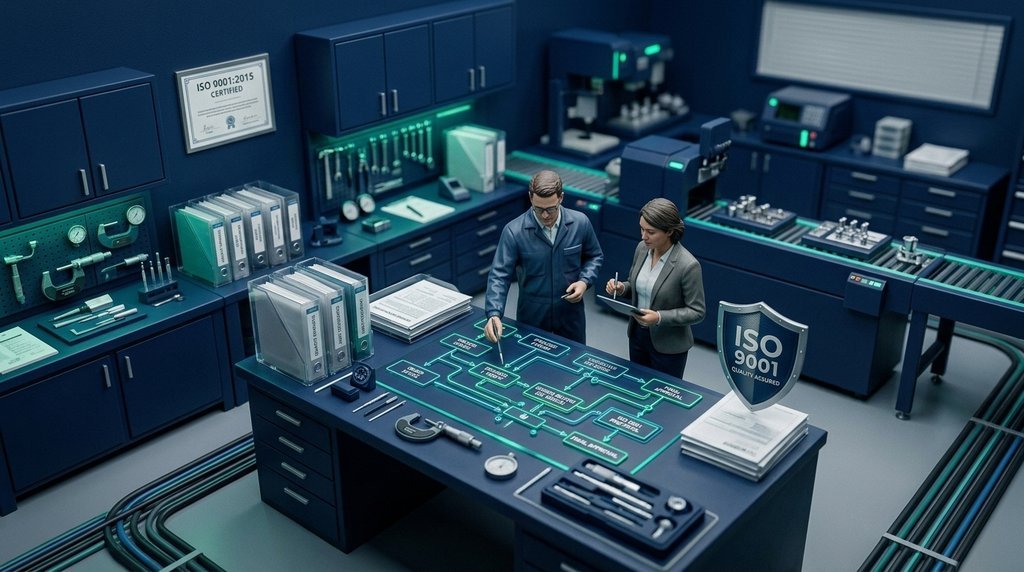
The same management system clauses appear across ISO 9001, 27001, 42001, 14001 and 45001. These guides explain what each one actually asks for, in plain English.
Practical, plain-English guides to the clauses of the ISO management system standards, written by a working ISO Lead Auditor. Each one explains what the clause actually requires, what auditors look for, and how to satisfy it without inventing paperwork nobody uses.
The guides are split into two groups, and the split matters more than it first appears.
Why the guides are split this way
The modern management system standards share a common high-level structure, often called Annex SL. That is why ISO 9001, ISO 45001, ISO 14001, ISO 27001 and ISO 42001 all have a clause 4 for context, a clause 6 for planning, a clause 9 for performance evaluation, and so on. Those common clauses support every standard you hold, which is exactly why an integrated management system is cheaper to run than several parallel ones: you build the backbone once.
Each standard then adds requirements specific to its discipline, and those are not transferable. Clause 8.2 is the clearest warning. In ISO 9001 it covers requirements for products and services; in ISO 45001 it is emergency preparedness and response; in ISO 14001 it is also emergency preparedness and response. Same clause number, entirely different requirements. So the standard-specific guides are grouped under the standard they belong to, and should be read that way.
Common clauses: these support every standard
Build these once and they serve your quality, safety, environmental, information security and AI management systems together.
Clause
What it covers
Guide
4.1
Understanding the organisation and its context: determining your internal and external issues, and choosing the method yourself
Competence for AI use: the free training programs now offered by OpenAI and Anthropic, and how to turn them into the competence evidence the clause asks you to retain
Note that ISO 45001 clause 8.2 is emergency preparedness, while ISO 9001 clause 8.2 covers requirements for products and services. The numbers do not transfer between standards.
ISO 27001 specific requirements
Requirement
What it covers
Guide
Annex A
The information security controls, and how to decide which ones apply to you
Every guide here is written on the same principle: a management system should carry the least administrative overhead the standard will allow, and conformity should be a by-product of running the business well rather than a scramble before the surveillance audit. If that idea is new, start with what a Streamline management system is.
More guides are added as we write them. If there is a clause you would like covered, tell us and we will put it on the list.
If you would rather talk a clause through than read about it, contact us. You will deal directly with an experienced ISO auditor. Email hello@streamline.business or call Brisbane 07 3667 8280, Sydney 02 8315 7780 or Melbourne 03 9034 3990.
Om nom nom... COOKIES! The essential ones keep our site working, and a few others help us see how it is used so we can make it better. Your call: accept the whole batch, keep it to essentials only, or pick your preferences. The full recipe is in our privacy policy.
Cookie Preferences
Manage your cookie preferences below:
Essential cookies enable basic functions and are necessary for the proper function of the website.
Name
Description
Duration
Cookie Preferences
This cookie is used to store the user's cookie consent preferences.
30 days
You can find more information in our Privacy Policy and .