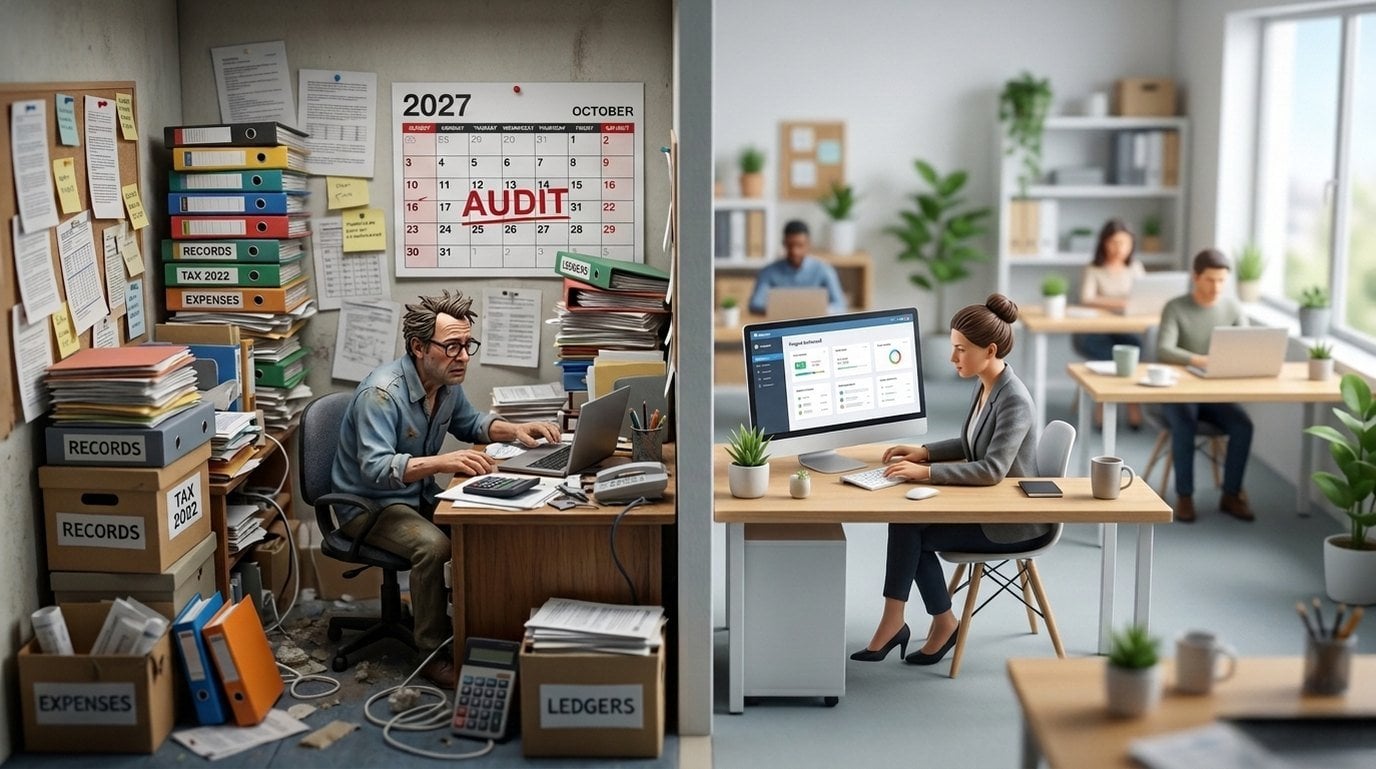
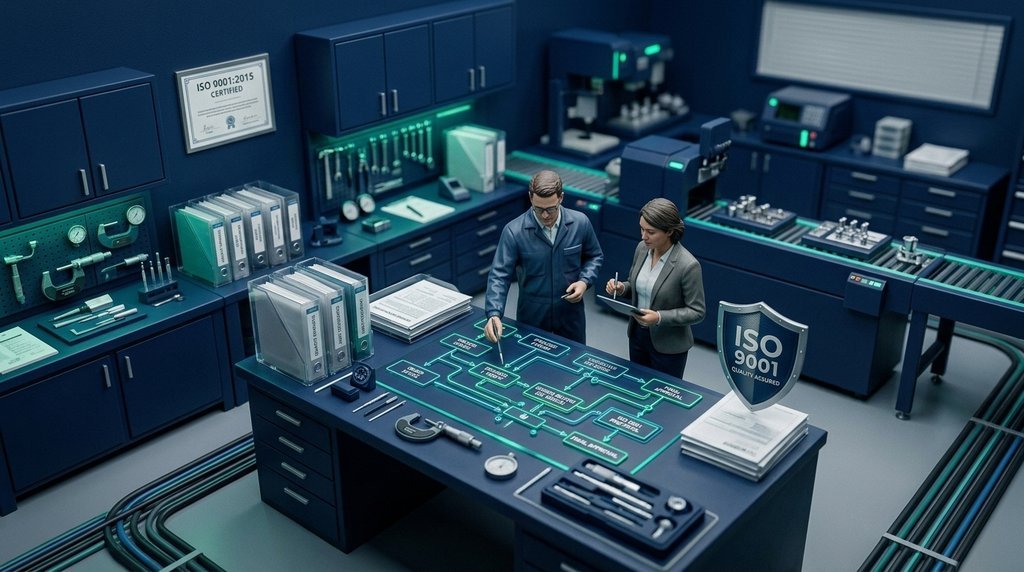
A Streamline management system is a management system built around how your business already runs, not bolted on beside it. It carries the least administrative overhead the standard will allow, every part of it has to earn its place by adding value, and it follows your actual operations and processes rather than a template. The practical test is simple: conformity, compliance and continual improvement should fall out of business as usual, not be manufactured in a panic three days before the surveillance audit.
That last point is the whole philosophy in one line. If your system only produces evidence when an audit is looming, it is not running your business. It is a separate job you do for the auditor.
In a well designed system the records come out of the work itself, so the evidence an auditor asks for already exists.
The annual scramble is the symptom
Most people reading this know the pattern. The surveillance audit is booked. Someone realises the internal audit has not been done, the management review has not been held, the objectives have not been measured since last year, and the corrective actions from the previous audit were closed on paper but never really actioned. So a week disappears into back-filling records, and the system limps through another audit.
The certificate survives. The business gets nothing.
The difference is not effort. It is whether the system was designed to produce evidence as a by-product of the work.
I see this constantly, and it is almost never because people are lazy. It happens because the system was designed as a parallel set of activities that nobody needs in order to do their job. Nothing in the daily running of the business produces the evidence, so the evidence has to be created separately, and separate work only gets done when there is a deadline.
The four principles
1. Minimal administrative overhead
Every document, register and form is a standing cost. Someone has to complete it, someone has to review it, and someone has to keep it current forever. A Streamline system carries only what the standard requires plus what the business genuinely uses, and nothing else.
That means no 200 page manual that restates the standard back to itself. No procedure for a process two people run intuitively and correctly every day. No form that exists only so a box can be ticked. If a document does not change a decision or record something you would want recorded anyway, it should not exist.
2. It must always add value
This is the filter I apply to every element of a system I design. What is this for? Who uses it? What would break if we removed it?
A well designed management system should make the business easier to run: clearer responsibilities, fewer repeat mistakes, faster onboarding, better data for decisions. If a client cannot tell me what a part of their system is actually for, that part is decoration, and decoration is what turns a management system into a burden people resent.
3. Aligned with operations and processes
The system should describe how the work is genuinely done. Not an idealised version, not a generic template with your logo on it, and not the way a consultant thinks your industry works.
This is why I walk the floor before writing anything. The processes you already run, the checks your people already do, the records you already keep for commercial reasons: that is the raw material. A system built on top of real operations is one people can follow without being told, because it is just their job written down. A system that contradicts real operations creates a permanent gap between what the documents say and what actually happens, and that gap is exactly what an auditor finds.
4. Conformity, compliance and continual improvement as by-products of business as usual
This is the pay-off from the first three. Get the system aligned with the way you work and the evidence generates itself:
You review supplier performance because you need reliable suppliers, and that satisfies the standard’s requirements at the same time.
You investigate a customer complaint because you want to keep the customer, and the corrective action record is a by-product.
You track on-time delivery and rework because they cost you money, and those same numbers are your clause 6.2 objectives.
You hold a monthly leadership meeting because you run a business, and with the right standing agenda items it becomes your management review.
You keep calibration and training records because you would be reckless not to, and they are the competence and equipment evidence the auditor asks for.
None of that is extra work. It is the work, captured once, in a form that serves both the business and the standard.
What it looks like at the audit
The difference shows up immediately in an audit. In a system built this way, the auditor asks how you control a process and the person who runs it answers from experience, then produces the record from where it already lives. Nobody is hunting for a folder. Nobody is explaining that they normally do it differently.
In a scrambled system, the manager answers on everyone’s behalf, the records all carry dates from the same fortnight, and the objectives have a target but no data. Experienced auditors recognise that pattern in the first hour, and it invites a much harder look at everything else.
Best practice, not extra practice
The framing I use with clients is that ISO conformity and legal compliance should be a by-product of best practice, not an additional practice.
Most of what the standards ask for is what a well run business does anyway: understand your context and the parties you serve, set measurable goals, make sure people are competent, control your processes, check whether they are working, and fix what is not. Read clause 4.2 interested parties or clause 6.2 objectives with a commercial eye and they are sensible management, not bureaucracy.
The standard is not asking you to run your business differently. It is asking you to run it deliberately, and to be able to show it.
Where the admin actually belongs
None of this means a system with no records. Records are what turn “we do that” into something you can demonstrate, and they are the difference between passing an audit and arguing with an auditor.
The distinction is between records that come from the work and records that exist for the audit. A delivery log, a complaint file, a maintenance schedule, a training matrix: all of these come from the work. A separate quality-only spreadsheet that duplicates data already sitting in your job management system comes from the audit. The first kind is worth keeping. The second kind is the overhead we design out.
Running more than one standard
The same thinking is what makes an integrated management system so much cheaper to run than several parallel ones. Quality, safety, environment and information security share the same backbone: context, leadership, objectives, competence, internal audit, management review. Build that backbone once, add the discipline-specific parts on top, and you carry one system rather than three.
A management system designed around how your business actually operates, with the minimum administrative overhead the standard allows. Every element has to add value, and conformity, compliance and continual improvement come out of business as usual rather than being assembled before an audit.
Does a lean system still pass certification?
Yes, and usually more comfortably. Certification requires conformity with the standard and evidence that the system is implemented, not a large volume of documentation. A smaller system that people genuinely follow produces better evidence than a large one they ignore.
How do you reduce administrative overhead without failing the standard?
Keep what the standard mandates and what the business genuinely uses, and remove the rest. Use records the work already generates instead of creating parallel ones, and make sure required activities like internal audit and management review sit inside meetings and routines you already hold.
Why do so many systems only come alive before the surveillance audit?
Because they were designed as separate activities rather than built into the way the business runs. If nothing in the normal week produces the evidence, the evidence only appears when a deadline forces it.
Can you fix a system that is already like this?
Usually, and it is often quicker than starting again. The work is stripping out what nobody uses, re-pointing the system at the records and meetings you already have, and closing the gap between what the documents say and what actually happens.
How Streamline can help
Streamline designs, implements, audits and mentors practical ISO management systems for Australian businesses, built the way described above. We can build the system with you, mentor your team while they build it themselves, or provide the independent internal audit that keeps it honest. You deal directly with an experienced ISO auditor who knows what accredited certification bodies actually look for. See our management system design services.
Speak with an experienced ISO auditor
If your system feels like a burden rather than a benefit, contact us. Email hello@streamline.business or call Brisbane 07 3667 8280, Sydney 02 8315 7780 or Melbourne 03 9034 3990.
General guidance only. This article is general information, not legal, financial, safety or compliance advice, and it does not take account of your specific circumstances. Streamline ISO Consultants are ISO management-system consultants, not lawyers or licensed advisers. Standards, laws and regulator guidance change, and details were correct only at the time of writing. Always seek professional advice before acting. See our full Disclaimer.
Stay in the Loop
Get an email when we post an article. Your email address will not be used for marketing, and you can unsubscribe at any time.
Om nom nom... COOKIES! The essential ones keep our site working, and a few others help us see how it is used so we can make it better. Your call: accept the whole batch, keep it to essentials only, or pick your preferences. The full recipe is in our privacy policy.
Cookie Preferences
Manage your cookie preferences below:
Essential cookies enable basic functions and are necessary for the proper function of the website.
Name
Description
Duration
Cookie Preferences
This cookie is used to store the user's cookie consent preferences.
30 days
You can find more information in our Privacy Policy and .