Refrigeration Controller Attacks: What ISO 27001 and HACCP Auditors Will Ask
An independent temperature alarm that reaches someone overnight is what separated the stores that kept their stock from those that lost it.
In October, attackers reached into the refrigeration systems of hundreds of French supermarkets and turned the fridges into ovens. Within weeks, the Pentagon confirmed it was treating a run of freezer failures at United States military base stores as a suspected cyber attack. Refrigeration controllers have quietly become one of the most talked about cyber risks of the year.
For Australian supermarkets, cold stores, food manufacturers, laboratories and health services, the lesson is practical. The equipment that keeps stock safe is often connected to the internet so a contractor can maintain it, and it often sits outside the information security program. This article covers what is known, what is still unknown, and the questions an ISO 27001 or HACCP system should be able to answer.
What happened in France
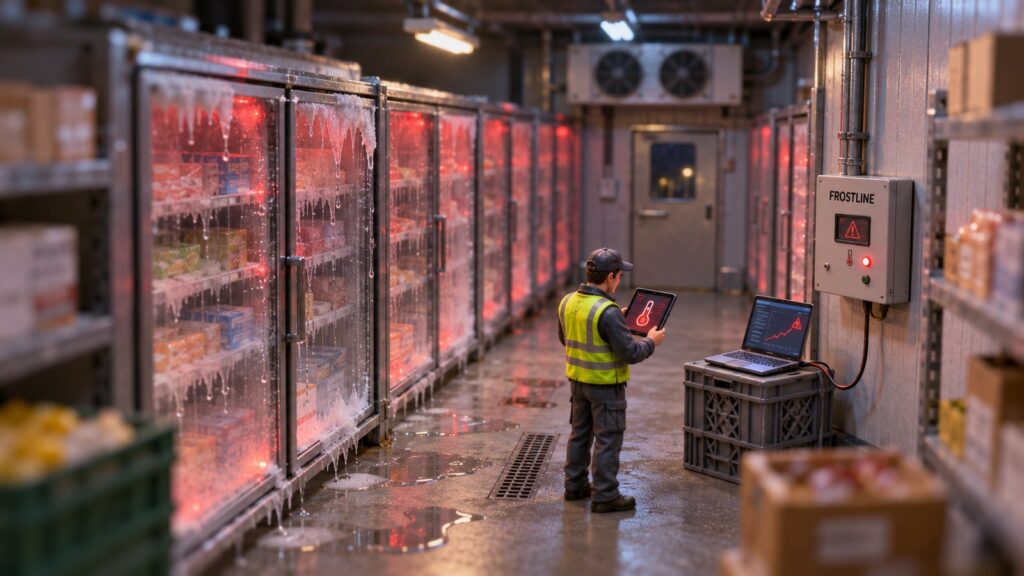
On the night of 11 to 12 October 2026, refrigeration controllers in French supermarkets were remotely switched into defrost mode. In some Intermarché and Netto stores, cabinets and cold rooms reached around 50°C and stayed there for roughly six hours. At least 350 establishments were reported affected across retailers including Les Mousquetaires, Carrefour, Coopérative U and Monoprix, and a second wave followed the next night. Le Monde reported that defrost cycles on some units were stretched from one hour to as long as eight, which delayed temperature alarms and deepened the losses.
The French cyber security agency, ANSSI, first warned operators about Danfoss AK-SC and AK-SM controllers and later added Copeland and Dixell XWEB controllers to its advisory. Danfoss said most affected units were older AK-SM 800 and AK-SC 355 models, along with some AK-SM 800A units running outdated firmware. How the attackers got in has not been publicly confirmed, although one retailer, E.Leclerc, said the attack reached its stores through a refrigeration equipment supplier. Security firm Sekoia reported related cases in Spain, Portugal, Poland, Germany and Belgium.
Two details stand out for any business that relies on cold storage. Intermarché said its insurance does not cover the incident, and brokers told Reuters that cyber policies commonly exclude physical loss. And the stores that kept their stock were generally the ones where someone responded quickly to an alarm in the early hours.
The United States military base investigation
On 29 October, Reuters reported that the Pentagon is treating freezer malfunctions at at least six military commissaries in late August as a suspected hack. At Fort Huachuca in Arizona, a freezer went into defrost mode overnight and spoiled its contents. A unit of US Cyber Command is investigating, and the Army Criminal Investigation Division’s Cyber Field Office is working with French law enforcement. Reuters could not confirm whether the US and French incidents are connected or which controller brands were used on the bases.
Why it matters in Australia
In August, researchers at Claroty’s Team82 published vulnerabilities in the Danfoss AK-SM 800A and the Copeland XWEB Pro, two supervisory controllers widely used in food retail and cold chain logistics. The vendors released fixed firmware, and Claroty warned of a significant risk for Australian businesses, naming distribution centres, supermarkets and healthcare facilities that store temperature-sensitive pharmaceuticals. Nobody has publicly linked those specific flaws to the French attack.
At the time of writing, we have found no public reports of Australian sites being affected and no ASD alert on this campaign. The exposure is still real. Controllers are commonly connected so a refrigeration contractor can monitor and adjust them remotely, which means the contractor’s access becomes part of the perimeter. Regional areas face a higher consequence, with fewer stores, longer resupply times and less spare cold storage, a point Claroty’s chief technology officer made to Cyber Daily.
Update, 9 November 2026: France names Iran’s Revolutionary Guard
On 9 November France formally attributed the October attacks. A five-page report from its Cyber Crisis Coordination Centre (CERTFR-2026-CTI-009), which brings together ANSSI, the military’s cyber command and the DGSE and DGSI intelligence services, names Shahid Kaveh, a cyber unit of Iran’s Islamic Revolutionary Guard Corps. Foreign Minister Jean-Noël Barrot confirmed the attribution at a G7 ministerial meeting in Paris and called the sabotage “unprecedented in its scale and aggressiveness”. According to The Record, about 700 French grocery stores were affected, there were at least 15 fires, and food losses were extensive.
France has summoned Iran’s ambassador and will pursue European sanctions. The Paris prosecutor has opened a judicial investigation into the head of the unit and two deputies and requested international arrest warrants. The same report links the unit to attacks on Schneider Electric equipment at several small French hydroelectric sites.
Two things change for an Australian business with connected refrigeration or building controls.
The threat is a state actor, not a nuisance. A campaign run by a state military unit, against civilian food retail, across several countries, is a different input to your risk assessment from opportunistic hacktivism. ISO 27001 control A.5.7 asks you to collect and analyse threat intelligence and act on it; this is exactly the kind of development it is meant to catch, even though there is still no ASD alert. Our article on ISO 27001 threat intelligence covers how a small business can do that in fifteen minutes a week.
Old equipment is the soft spot. The campaign has leaned on older controllers that are reachable from the internet. Check whether your asset inventory (A.5.9) records the vendor’s support status for each controller, and whether vulnerability management (A.8.8) has a plan for units that will never receive another patch: isolate them, put them behind a VPN with logged contractor access, or schedule their replacement. “We will patch it” is not a plan for a device the vendor no longer supports.
At the time of this update we have still found no ASD alert and no reported Australian incident.
Update, 5 November 2026: five US agencies issue a warning, and a second wave hits Europe
On 5 November, CISA, the FBI, the Department of Health and Human Services, the Department of Agriculture and the Department of Transportation issued a joint fact sheet urging operators to harden industrial refrigeration and cold chain monitoring systems. It warns that malicious cyber actors are targeting these systems globally, and could exploit unpatched or internet-accessible controllers to force units into continuous heating and defrost cycles, or to hide current temperatures from the people watching them. It names no vendor and attributes the activity to no one.
The same week, more than 100 stores in Belgium, Estonia, Ireland, Luxembourg, the Netherlands and Sweden reported fridges and freezers warming after remote takeovers overnight on 1 to 2 November. France’s blood service, the EFS, said temperature and defrost thresholds were raised at three plasma cold storage sites through a refrigeration equipment supplier. Its monitoring caught the change in time and no blood products were compromised. Investigators have not said whether the October and November waves are connected.
The eight US mitigations map neatly onto an ISO 27001 system and a HACCP plan:
Keep controllers off the public internet, with any remote access behind a maintained firewall: ISO 27001 controls 8.20 and 8.21.
Put operational technology on its own network segment, separate from business systems: 8.22.
Change default passwords and use phishing-resistant multi-factor authentication where feasible: 5.17 and 8.5.
Keep firmware current and retire end-of-life units: 8.8, with the asset inventory in 5.9 showing what is unsupported.
Allowlist the devices and addresses permitted to make changes: 5.15 and 8.2.
Keep tested offsite, offline backups, including controller configurations: 8.13.
Log and review activity, capturing network traffic where the controller cannot log: 8.15 and 8.16.
Set reasonable setpoint limits and alert on deviations: 8.16 on the security side, and on the food safety side the critical limits, monitoring and corrective action steps of a HACCP plan (principles 3 to 5).
At the time of this update we have still found no ASD alert and no reported Australian incident. The same controllers are installed here, and the US list is a sensible checklist for any Australian cold chain operator to work through now, rather than after a local alert.
Where this sits in ISO 27001 and HACCP
A refrigeration controller is operational technology, and it fits inside an ISO 27001 information security management system once it is connected to a network. For food businesses it also sits at the heart of the food safety plan, because cold storage temperature is a critical control point. The table maps the main questions to both.
Question
ISO 27001:2022 Annex A
Food safety and HACCP
Do we know every controller, its model, firmware and support status?
A.5.9 inventory of information and other associated assets
Equipment register for cold storage and critical control point monitoring
Approved supplier and maintenance contractor controls
Are management interfaces separated from the internet and the office network?
A.8.20 networks security, A.8.22 segregation of networks
Protection of the equipment that controls a critical limit
Are firmware updates applied, and is unsupported equipment on a replacement plan?
A.8.8 management of technical vulnerabilities
Preventive maintenance program
Would we notice an unplanned setpoint or defrost change at 3am?
A.8.16 monitoring activities, A.5.24 to A.5.26 incident management
HACCP principles 4 and 5: monitoring and corrective action
Can we trust the temperature records after an incident?
A.8.15 logging, A.5.28 collection of evidence
HACCP principle 7: records, and product disposition decisions
Chilled potentially hazardous food generally has to be held at 5°C or below under the Food Standards Code, and frozen food has to stay frozen. An attack that delays alarms defeats the monitoring step, so the food safety plan should not rely only on the controller that the attacker can change. Our articles on HACCP certification and ISO 27001 cover each system in more detail.
Six questions to ask now
Is refrigeration in scope? Check whether the ISMS scope and asset register include refrigeration, building management and other connected plant, or whether these sit with facilities and are never reviewed.
Who has remote access? List every path into the controllers: contractor VPNs, cellular routers, port forwards and vendor cloud portals. Each contractor should use named accounts with strong authentication, and access should be logged and easy to revoke.
What firmware is running? Record the model and firmware of each unit against the vendor’s current release and support status. Units the vendor no longer supports need a named owner and a replacement budget.
Are the interfaces exposed? Management interfaces should not be reachable from the open internet, and the refrigeration network should be separated from guest Wi-Fi and the office network.
Is there an independent alarm? A temperature alarm that does not depend on the controller, and that reaches a person who can act overnight, is what separated the French stores that kept their stock from those that lost it.
What is the plan for a 3am event? The response plan should cover checking readings at the unit, stopping unauthorised changes, calling the technician, assessing and recording food safety decisions, restoring known-good settings, and checking what the insurance policy actually covers.
Who should be paying attention
Supermarkets and food retail, especially multi-site operators where one compromised management platform can change many stores at once.
Cold storage, distribution and logistics, where a single cold room can hold millions of dollars of stock.
Food manufacturers working to HACCP, ISO 22000 or FSSC 22000, where storage temperature is a critical limit.
Laboratories, where sample and reagent storage conditions affect the validity of results under ISO 17025.
Health services and pharmacies, where vaccine and medicine fridges are part of clinical quality. Our article on ISO 9001 for Aboriginal Health Services covers cold chain monitoring in a health setting.
Streamline helps food, logistics, laboratory and health organisations bring operational technology into their management systems. That includes ISO 27001 scoping and risk assessment that covers connected plant, supplier access controls, internal audits of refrigeration and building systems, and aligning HACCP monitoring and corrective action with information security incident response. For teams that want to build this capability in-house, our ISO mentoring service guides a capable staff member through it. Get in touch for a conversation.
What happened to the supermarket fridges in France?
On the night of 11 to 12 October 2026, attackers remotely switched refrigeration controllers in hundreds of French supermarkets into defrost mode. Cabinets and cold rooms in some stores reached around 50°C for about six hours and stock was thrown out. French authorities are investigating and no group has claimed responsibility.
Which refrigeration controllers were involved?
The French cyber security agency first warned about Danfoss AK-SC and AK-SM controllers, then added Copeland and Dixell XWEB controllers to its advisory. Danfoss said most affected units were older models or ran outdated firmware. How the attackers got in has not been publicly confirmed.
Have any Australian businesses been affected?
At the time of writing, we have found no public reports of Australian sites being affected and no ASD alert on this campaign. The same controller brands are used in Australian supermarkets, cold stores and distribution centres, and researchers have warned that the published vulnerabilities apply here too.
Does ISO 27001 cover refrigeration and building control systems?
It can, and it should when those systems are connected to a network or reached remotely by a contractor. The scope, asset inventory, supplier controls, network separation, vulnerability management and monitoring controls in ISO 27001 all apply to operational technology inside the scope of the ISMS.
How does a refrigeration cyber attack affect HACCP?
Cold storage temperature is a critical control point for most food businesses. An attack that changes setpoints or delays alarms defeats the monitoring step, and an affected batch has to be treated under the corrective action procedure. Temperature records may also be unreliable if the controller that produces them has been tampered with.
What is the fastest way to reduce the risk?
Find every refrigeration controller and the ways it can be reached remotely, take management interfaces off the open internet, update or replace unsupported units, give contractors named and logged accounts, and make sure an independent temperature alarm reaches someone who can act overnight.
Facts checked 11 November 2026. Next review if ASD issues an alert or an Australian incident is reported.
General guidance only. This article is general information, not legal, financial, safety or compliance advice, and it does not take account of your specific circumstances. Streamline ISO Consultants are ISO management-system consultants, not lawyers or licensed advisers. Standards, laws and regulator guidance change, and details were correct only at the time of writing. Always seek professional advice before acting. See our full Disclaimer.
Stay in the Loop
Get an email when we post an article. Your email address will not be used for marketing, and you can unsubscribe at any time.
Om nom nom... COOKIES! The essential ones keep our site working, and a few others help us see how it is used so we can make it better. Your call: accept the whole batch, keep it to essentials only, or pick your preferences. The full recipe is in our privacy policy.
Cookie Preferences
Manage your cookie preferences below:
Essential cookies enable basic functions and are necessary for the proper function of the website.
Name
Description
Duration
Cookie Preferences
This cookie is used to store the user's cookie consent preferences.
30 days
You can find more information in our Privacy Policy and .