They Had a Risk Assessment. Five Workers Still Had Lead in Their Blood.
On 7 August 2026 the South Australian Employment Court convicted AGL Torrens Island Pty Ltd and fined it $60,000, plus SafeWork SA’s costs of $2,640, over lead exposure during the decommissioning of the Torrens Island A Power Station.
The facts are worth reading slowly, because the failure is not the one you would expect.
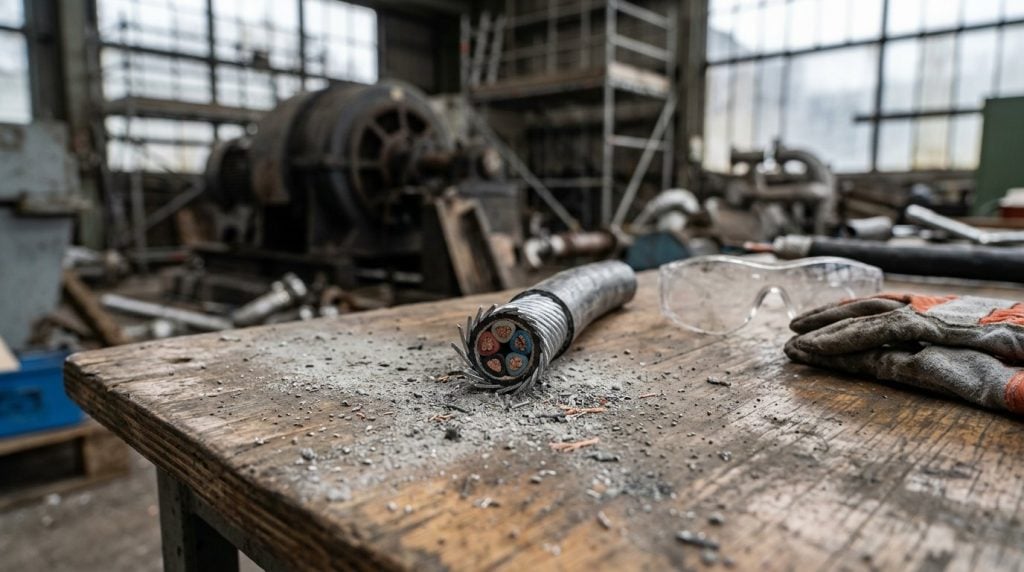
Between October 2022 and April 2023, workers were de-energising, cutting and removing paper insulated lead covered cables. The cables were cut into one-metre lengths and put into drums for disposal. That work generated dust and debris, including lead dust.
The workers were not sent in unprotected. They were provided with long sleeves, long pants, boots, safety glasses, hard hats and gloves.
Six items of personal protective equipment. None of them a respirator.
Testing in April 2023 found lead in the workplace dust. Testing of the workers found five of them had elevated blood lead levels. Work stopped on 11 April 2023, and before it resumed the company added full-face respirators and disposable coveralls.
This is a hazard identification failure, not a paperwork one
Deputy President Judge Crawley said he had difficulty understanding how the defendant failed to recognise the risk the task created.
Removing and cutting up large quantities of paper insulated lead covered cables should have been an obvious source of the risk of lead exposure needing to be addressed.
And then the line that belongs on the wall of every safety committee room in the country:
Risk assessment protocols are only as effective as the way in which they are implemented.
That sentence is the best short statement of ISO 45001 clause 9.2 you will read this year, and it came from a judge rather than an auditor.
Notice what is not being criticised. Nobody said there was no risk assessment. Nobody said there was no PPE programme. Six items of PPE is evidence of a process that ran. The process ran, and it produced an answer that missed the routes of entry that mattered.
Lead dust does not hurt you through your forearms. It hurts you when you breathe it in, or when it travels from your hands to your mouth.
Why an audit finds this and a document review does not
If you had asked to see the paperwork on this job, it would have looked reasonable. A task, a risk assessment, a PPE list, six items issued and presumably signed for.
The gap only becomes visible when you stand next to the work and ask a different question: what are the routes of entry here, and which control addresses each one?
That is the difference between auditing the document and auditing the task, and it is why clause 9.2 says internal audit rather than internal document review. An auditor who walks the job and watches a cable being cut asks about the dust. An auditor who reads the register sees six ticks and moves on.
The same pattern turned up in the South Australian industrial manslaughter charges we wrote about in the guard was there and someone switched it off. Different hazard, same shape: the control existed on paper and did not do its job in the world.
PPE was the bottom of the hierarchy, and it was all there was
There is a second-order problem here that is easy to miss.
The hierarchy of control puts personal protective equipment last, because it protects one person, only while worn correctly, and it fails without warning. Everything above it works further upstream. Elimination and substitution remove the hazard or replace it with something less harmful, engineering controls like extraction or wet cutting and isolation cut exposure at the source, and administrative controls change how the work is done. PPE acts only at the person, and only while it is the right item, worn properly.
When PPE is your primary control, you have no margin. Get the selection wrong and there is nothing underneath to catch it. That is exactly what happened here. On the regulator’s account the organisation was relying on the least reliable layer of the hierarchy, and had chosen the wrong item within it.
Worth asking of your own high-risk tasks: if the PPE on this job turned out to be the wrong PPE, what else would be protecting the worker? If the honest answer is nothing, then your PPE selection is not a detail. It is the whole control.
Six items of personal protective equipment were issued for this task. None of them covered the routes of entry that mattered.
The health monitoring point, which is the one that stings
Lead risk work is one of the few areas where the WHS Regulations do not leave monitoring to your discretion. Where workers carry out lead risk work, health monitoring is required, and it includes biological monitoring, meaning blood lead measurement, with defined levels at which a worker must be removed from that work.
So consider the sequence in this case. The dust testing came in April 2023. The blood testing followed. Five workers had elevated levels.
Health monitoring worked exactly as designed. It detected exposure. But detection is not prevention, and a blood test tells you what has already entered a person’s body. By the time biological monitoring flags a result, the control failure is months old and it is inside somebody.
That is not an argument against health monitoring. It is an argument about what you are entitled to conclude from it. A clean set of results tells you that your controls held for that group over that period. It does not tell you that your hazard identification was complete. Those are different questions, and only the second one prevents anything.
In ISO 45001 terms, health monitoring is part of clause 9.1, monitoring and measurement. It sits downstream of 6.1.2 hazard identification and 8.1.2 hierarchy of controls, and it cannot compensate for either of them being wrong.
What to check
Not a programme. Four questions, asked about your genuinely hazardous tasks.
Take one high-risk task and list the routes of entry. Inhalation, skin absorption, ingestion, injection, and physical mechanisms like noise or vibration. Then map each control to a route. Any route without a control is your gap, and it will not be visible in the register.
Look specifically at anything that disturbs old material. Demolition, decommissioning, refurbishment and maintenance are where hazards that were stable for decades get released. Lead, asbestos, silica, synthetic mineral fibre and coatings all behave this way. The risk assessment for the job before the disturbance is not the risk assessment for the disturbance.
Find the tasks where PPE is the only control. For each one, ask what happens if the selection is wrong. That question alone will find your exposures.
Check whether health monitoring results ever change anything. If results come back, get filed and never enter the risk assessment or the improvement register, you have a compliance activity rather than a control loop.
Separately, and looking forward rather than back, the national exposure limits for airborne contaminants change on 1 December 2026. If you are reviewing chemical exposure now, do it against the new list rather than the old one. We have set out what changes in the new workplace exposure limits, including which substances are not moving.
SafeWork SA’s Executive Director put it plainly: effective safety management depends not only on having systems in place, but on correctly identifying and addressing workplace risks before workers are put in harm’s way. The judge said the same thing in fewer words. A protocol you implemented badly is not a protocol.
Streamline are ISO management system consultants, not occupational hygienists. Work health and safety duties and lead risk work requirements differ between jurisdictions, so confirm the position with your own regulator.
General guidance only. This article is general information, not legal, financial, safety or compliance advice, and it does not take account of your specific circumstances. Streamline ISO Consultants are ISO management-system consultants, not lawyers or licensed advisers. Standards, laws and regulator guidance change, and details were correct only at the time of writing. Always seek professional advice before acting. See our full Disclaimer.
Stay in the Loop
Get an email when we post an article. Your email address will not be used for marketing, and you can unsubscribe at any time.
Om nom nom... COOKIES! The essential ones keep our site working, and a few others help us see how it is used so we can make it better. Your call: accept the whole batch, keep it to essentials only, or pick your preferences. The full recipe is in our privacy policy.
Cookie Preferences
Manage your cookie preferences below:
Essential cookies enable basic functions and are necessary for the proper function of the website.
Name
Description
Duration
Cookie Preferences
This cookie is used to store the user's cookie consent preferences.
30 days
You can find more information in our Privacy Policy and .