Your Exposure Limits Change on 1 December. Silica Is Not One of Them.
On 1 December 2026 the Workplace exposure standards for airborne contaminants become the Workplace exposure limits for airborne contaminants. The transition period ends on 30 November, so there is no phase-in and no grace period. The day before, you comply with the old list. The day after, you comply with the new one.
It would be easy to file this as a renaming exercise. It is not. This is the first full review of the exposure standards since 2003, and three separate things are changing at once: some numbers move, one substance gets a national limit for the first time, and thirty-three substances stop having a limit at all.
The last of those is the one almost nobody is talking about, and it is the one that changes how you evidence compliance.
What changes
Thirty-one airborne contaminants have been added to the list. Most limits are unchanged, but a substantial number have been reduced, and a handful have gone up.
The reductions worth knowing about, if you run a workshop, a fabrication shop or a construction site:
Manganese falls from 1 mg/m³ to 0.1 mg/m³ inhalable and 0.02 mg/m³ respirable. If you weld, this is the one to look at first.
Portland cement falls from 10 mg/m³ to 1 mg/m³ for respirable dust.
Soft wood dust falls from 5 mg/m³ to 2 mg/m³.
Toluene falls from 50 ppm to 20 ppm, and acetone from 500 ppm to 250 ppm.
Beryllium falls from 0.002 mg/m³ to 0.00002 mg/m³, a hundredfold reduction.
A few went the other way. Hexane rises from 20 ppm to 50 ppm. So “the limits are all getting tighter” is not accurate either, and if you are briefing your team, it is worth being precise rather than alarming.
Six substances come off the list entirely because they are already prohibited from import, manufacture and use in Australia: aldrin, chlordane, DDT, dieldrin, endrin and heptachlor.
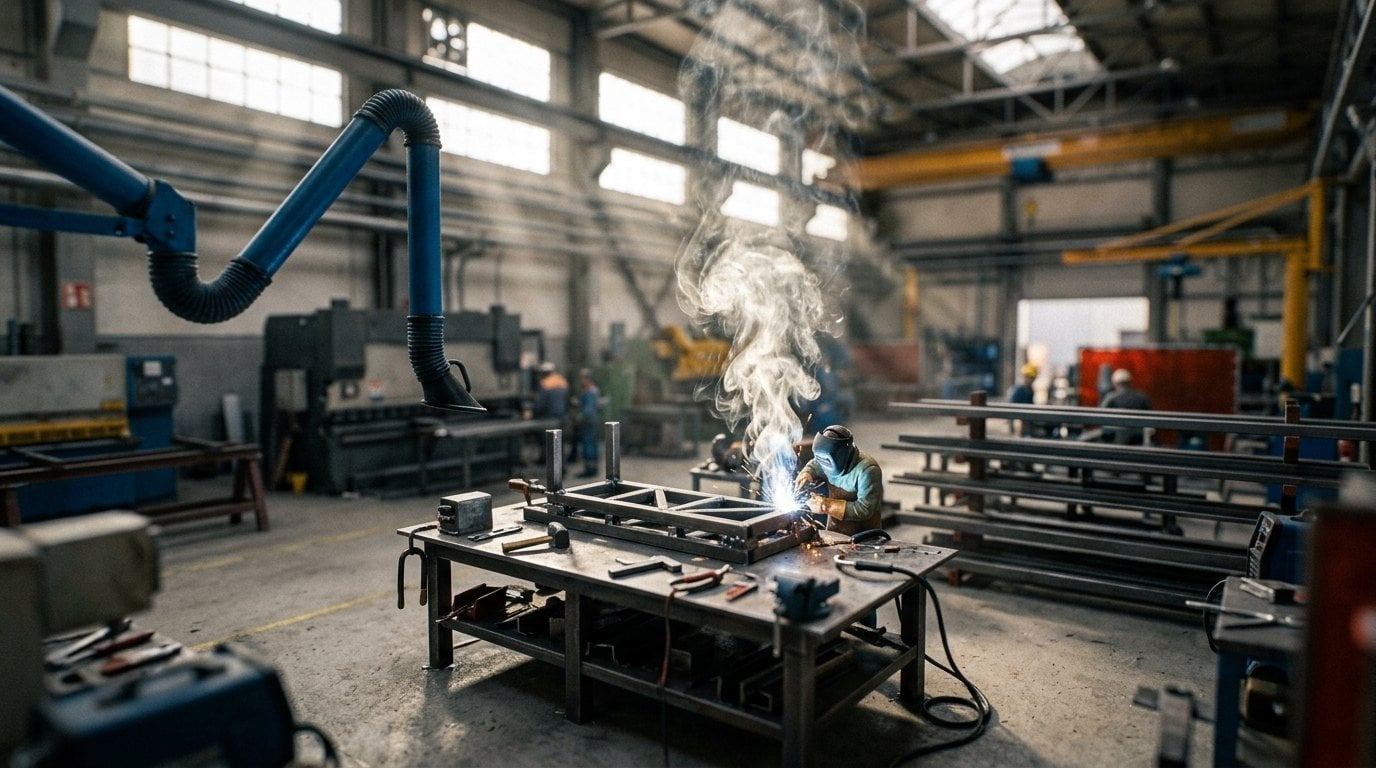
The extraction arm exists and it is on the register. Whether it was in position when the work happened is the audit question.
Diesel gets a number for the first time
From 1 December, diesel particulate matter carries a workplace exposure limit of 0.01 mg/m³, measured as respirable elemental carbon. There was no national limit before this.
That matters for mining, quarrying, tunnelling, construction, agriculture, transport and logistics, oil and gas, and vehicle maintenance. If you run diesel plant in a partially enclosed space, you now have a number you can be measured against, and 0.01 mg/m³ is not a generous one.
Safe Work Australia published a dedicated guide on diesel engine emissions on 30 July, alongside two guides on air monitoring. That is your starting point rather than a general search.
The silica correction
Here is the part that has been reported wrong in several places.
Respirable crystalline silica is not changing on 1 December. It is one of nine substances that WHS ministers pulled out for additional impact analysis before their limits will be updated. The others are benzene, chlorine, copper, formaldehyde, hydrogen cyanide, hydrogen sulphide, nitrogen dioxide and titanium dioxide.
Safe Work Australia’s position is explicit: until that analysis is complete and ministers have made a decision, the limit for those nine remains the same as the one in the current WES list.
So if someone has told you the silica limit drops in December, they have told you wrong. Your current obligation stands, unchanged, and a further change is coming at some unannounced later date. Both halves of that matter. Do not relax, and do not rebuild your controls around a number that has not been set.
Thirty-three substances with no limit at all
This is the real story, and it gets almost no coverage.
The review identified thirty-three airborne contaminants as non-threshold genotoxic carcinogens. These are substances that damage genetic material and can cause cancer, and for which no safe level of exposure can be established. From 1 December 2026, there will no longer be an exposure limit for any of them.
The list includes chromium VI compounds, ethylene oxide, vinyl chloride monomer, 1,3-butadiene, benzidine, MOCA, lead chromate, coal tar pitch volatiles, and polycyclic aromatic hydrocarbon mixtures containing benzo[a]pyrene. These are not exotic. Chromium VI turns up in welding stainless steel and in surface coatings.
Think about what removing the number does to your evidence. Today, if an inspector or an auditor asks how you manage chromium VI, you can hand over an air monitoring report showing results below the standard. From 1 December there is no standard to be below. The duty becomes eliminate the substance if you reasonably can, substitute something safer if you cannot, and otherwise minimise exposure so far as is reasonably practicable.
You cannot discharge that with a clean air sample. You discharge it with a documented decision trail: what you considered, why elimination was not reasonably practicable, what you substituted or engineered instead, and how you verified the control still works.
That is a documentation problem, and documentation problems take longer than measurement problems.
A limit is a ceiling, not a target
Worth saying plainly, because it is the single most common misunderstanding in this area, and Safe Work Australia says it themselves: the exposure limit is not the dividing line between a healthy and an unhealthy workplace. Individual susceptibility varies, and some people will be affected below the limit.
The legal duty is not “stay under the number”. The duty is to eliminate the risk so far as is reasonably practicable, and if you cannot eliminate it, to minimise it so far as is reasonably practicable, whether or not a limit exists. The limit sits on top of that as a line you must not cross.
One consequence catches people out. Respiratory protective equipment can be counted towards compliance with a limit, but only once all reasonably practicable higher order controls have been implemented and the equipment is worn correctly. PPE first is not a strategy. It is a finding.
What an auditor will actually ask for
If you hold ISO 45001, this transition touches four clauses, and none of them are satisfied by a single air monitoring report.
Clause 6.1.2, hazard identification and assessment of risks. Your hazard register and chemical register were built against the old list. Neither knows that manganese moved, or that diesel particulate now has a limit, or that thirty-three substances lost theirs. Re-baselining that against the WEL list is the first task, and it is a desk exercise you can start this week.
Clause 8.1, operational planning and control. Where a limit has tightened, the question is whether your existing controls still hold the exposure below the new number. Local exhaust ventilation sized for 1 mg/m³ of manganese was not designed for 0.02.
Clause 9.1, monitoring, measurement, analysis and evaluation. A monitoring programme is not one sample. It is a defined scope, a competent person, a frequency, a trigger for re-monitoring when the process changes, and a route from a result back into the risk assessment.
Clause 9.2, internal audit. This is where it surfaces if nobody has done the above. An exposure register that has never been re-baselined against a list that changed nine months ago is exactly the kind of thing a clause 9.2 internal audit exists to catch, and it is a far better place to find it than during a regulator visit.
Worth noting that SafeWork NSW already named hazardous substances as an inspection priority, with a specific question about whether air monitoring matches the exposures a business actually has. We wrote about what SafeWork NSW said it will inspect earlier this year. That question gets harder to answer well when the list underneath it has just changed.
What to do between now and December
Update, 1 October 2026. October is National Safe Work Month, and Safe Work Australia’s theme this year is “Safe work is for life”: protecting long-term health, not only preventing the injury that happens on the day. Occupational disease from airborne contaminants is exactly the harm that theme is about, and the 1 December change is the most concrete test of it in your system. If you want a Safe Work Month activity that changes something, re-baselining your chemical register against the new limits will do more than a poster.
There are now about two months left, and air monitoring has lead times. Engaging a competent person, scheduling sampling around representative work, waiting for laboratory results and then acting on them is not a November activity.
Re-baseline the register. Take your chemical and hazard registers, and check every substance you use or generate against the WEL list. Mark three categories: limit unchanged, limit reduced, limit removed. That gives you your work list.
Identify anything on the NTGC list. These need a different kind of evidence, not a different number. Start the elimination and substitution reasoning now and write it down as you go.
Check whether you generate diesel particulate. If you run diesel plant anywhere with restricted airflow, you have a new limit and probably no baseline data.
Book the monitoring. Where a limit has dropped and you have no recent data, you need a measurement before you can say anything credible about compliance.
Put the review on the calendar as a scheduled activity, with an owner and a date, rather than as something to get to. It is the ones that never get a date that turn up as findings.
The monitoring rules themselves are under review
There is a second thing happening while you prepare for December. Safe Work Australia has been consulting on the health and air monitoring requirements themselves, and on how they sit alongside the model Code of Practice and the supporting guidance. The stated reason for the review is that the current requirements are unclear, and that this is leading to low monitoring rates. Read that reason twice. The regulator has already formed a view that most duty holders are not monitoring, and a view like that reaches inspection priorities long before it reaches an amended regulation.
The consultation paper carried twenty-six discussion questions: 1 to 20 on health monitoring, 21 to 24 on air monitoring, and two open questions. Safe Work Australia also asked for evidence and data on where the current requirements are ambiguous in practice, which is exactly what anyone re-baselining a register against the new limits will run into over the next two months.
Feedback now goes to Safe Work Australia Members for consideration, and any final recommendations go to Commonwealth, state and territory WHS ministers, who are the final decision makers on amendments to the model WHS laws. No timeline has been published, so plan for December around the monitoring requirements as they stand today.
Submissions closed on 21 September 2026
Safe Work Australia says the feedback will inform recommendations to its Members. No timeline has been published, and the current health and air monitoring requirements apply unchanged until any amendment is made. We will update this article when an outcome is announced.
Managing exposure to airborne contaminants sits squarely inside an ISO 45001 occupational health and safety management system, and this transition is a good test of whether yours is a live system or a folder. A system that is working will already have flagged 1 December. A system that is not will discover it in an audit.
If you are unsure how much of your register is affected, a gap analysis against the new list is a short piece of work and it tells you the size of the problem before you commit to anything.
Streamline are ISO management system consultants, not occupational hygienists. Exposure limits are implemented through the WHS laws of each state and territory, so confirm the position with your own regulator.
General guidance only. This article is general information, not legal, financial, safety or compliance advice, and it does not take account of your specific circumstances. Streamline ISO Consultants are ISO management-system consultants, not lawyers or licensed advisers. Standards, laws and regulator guidance change, and details were correct only at the time of writing. Always seek professional advice before acting. See our full Disclaimer.
Stay in the Loop
Get an email when we post an article. Your email address will not be used for marketing, and you can unsubscribe at any time.
Om nom nom... COOKIES! The essential ones keep our site working, and a few others help us see how it is used so we can make it better. Your call: accept the whole batch, keep it to essentials only, or pick your preferences. The full recipe is in our privacy policy.
Cookie Preferences
Manage your cookie preferences below:
Essential cookies enable basic functions and are necessary for the proper function of the website.
Name
Description
Duration
Cookie Preferences
This cookie is used to store the user's cookie consent preferences.
30 days
You can find more information in our Privacy Policy and .