Inspection and Test Plans (ITPs) in Construction: What to Include, With a Free Template
An ITP plans the checks before the work starts, and the hold points stop the job until the work is released.
An inspection and test plan, or ITP, is how a builder or civil contractor plans quality control before the work starts and proves it afterwards. It lists every inspection and test the work needs, what “right” looks like for each one, who checks it, and where the job stops until someone signs it off. I prepare a lot of them, and the simplest way to explain an ITP is this: it is the quality version of a SWMS.
Free ITP template
Download our Inspection and Test Plan template (Excel). It includes a project header, hold, witness, inspection and review points with a drop-down, a worked example for a concrete footing, blank rows ready to complete, and a how-to tab. Free, no sign-up.
Short answer
An ITP sets out the inspections and tests for a work activity, with the acceptance criteria, reference documents, verification method, frequency, responsibility and record for each. Hold points stop work until released; witness points give the client the chance to attend; inspection and review points are the contractor’s own checks. Signed off as the work proceeds, a completed ITP is the evidence that the work was built to specification, and it is how most contractors meet the ISO 9001 requirements for controlling and releasing their work.
The quality version of a SWMS
Most contractors already understand a SWMS: before high-risk work starts, you think through the steps, the hazards and the controls, write them down, and check on the day that it is being done that way. An ITP applies the same discipline to quality. Before the work starts, you think through what has to be checked, what the acceptance criteria are and when the job has to stop for an inspection. Then you verify it as the work proceeds.
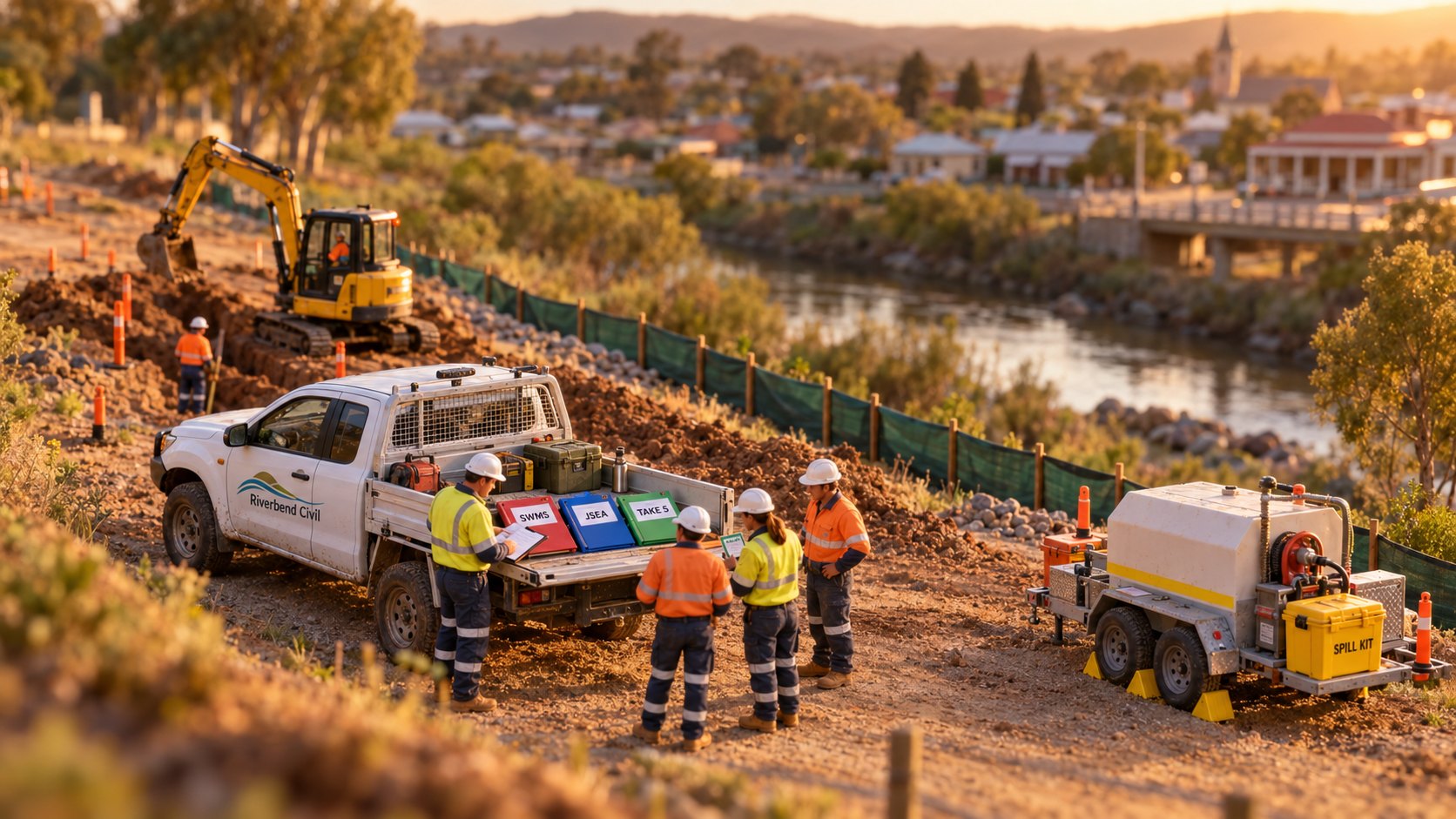
That is why the two sit so well together. A SWMS plans the work so nobody gets hurt. An ITP plans the checks so nothing has to be pulled out and done again. Both are only worth something if they are followed on site, and both should be signed by the people doing the work.
What goes in an ITP
Column
What it records
Item
A number for each inspection or test, so records can be filed against it.
Activity, inspection or test
What is being checked, in the order the work is done.
Acceptance criteria
What “right” looks like: dimensions, tolerances, grades, test results.
Reference
The drawing, specification clause or standard the criteria come from.
Verification method
How it is checked: measure, visual inspection, survey, laboratory test, document review.
Frequency
How often: once, each pour, each lot, per volume, daily.
Point type
Hold, witness, inspection or review.
Responsibility
Who carries out or signs off the check.
Record or evidence
Where the proof lives: test report, photos, survey record, delivery dockets.
Sign-off
Contractor and, where required, client or superintendent, with the date.
Hold, witness, inspection and review points
Point
What it means
Typical example
Hold (H)
Work must not proceed until the nominated person has inspected and released it in writing.
Reinforcement checked by the engineer before a pour.
Witness (W)
The client is given notice and may attend; work can proceed if they do not.
Concrete sampling or a pressure test.
Inspection (I)
An internal check by the contractor, recorded on the ITP.
Set-out, compaction, finishing.
Review (R)
A check of documents or records rather than the work itself.
Delivery dockets, test certificates, survey results.
Agree the hold and witness points with the client before the work starts, along with how much notice they need. Most disputes about ITPs come from a hold point that was never agreed or a witness notice that was never sent.
A worked example: concrete footing
Review: current drawings, specification and the ITP issued to the site team.
Inspection: set-out of the footing within tolerance.
Hold: excavation dimensions and founding material accepted by the engineer.
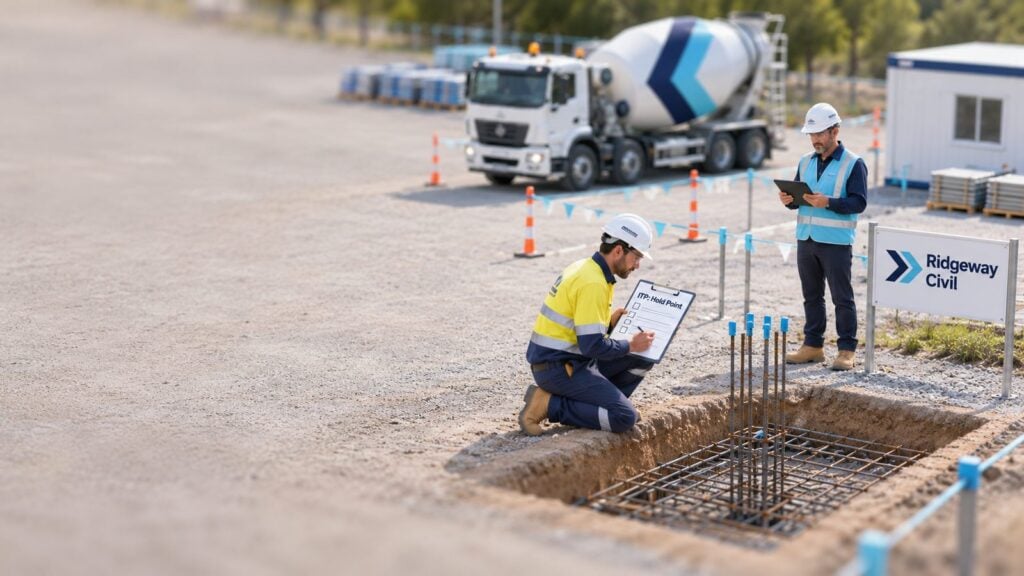
Hold: reinforcement size, spacing, cover and laps checked before the pour.
Inspection: concrete delivery dockets checked for grade and slump.
Witness: slump testing and test cylinders taken as specified.
Inspection: placement, compaction, finishing and curing.
Review: test results and records complete, and any nonconformances closed.
The template includes this example in full. Replace it with the requirements of your own specification.
Where the test requirements come from
The acceptance criteria, test methods and frequencies in an ITP come from the contract documents: the drawings, the project specification, and the standards and specifications they call up. On road and civil work that usually means the state road agency’s specifications, such as the Transport for NSW QA specifications or Queensland’s Transport and Main Roads technical specifications, along with the Australian Standards they reference. Always take the criteria from the current version the contract names, not from an old ITP.
Common ITP mistakes
Generic ITPs. A template copied from the last job that does not match this specification.
Criteria that just say “as per spec”. The person on site needs the number, not a reference to go and look it up.
Hold points without a release. The work went ahead, and nobody signed.
Sign-off after the fact. The ITP completed in the office at the end of the job.
Records that do not match the item numbers. The test report exists, but nobody can tell which item it supports.
Superseded references. Specifications and standards change; the ITP should cite the version in the contract.
ITPs and ISO 9001
ISO 9001 does not use the term ITP, but on a construction project an ITP is how most of clause 8 is met in practice. It is a big part of controlled conditions for the work (8.5.1), it provides the planned verification before work is released and records who released it (8.6), and failed inspections feed straight into the control of nonconforming outputs (8.7). Our guide to ISO 9001 clause 8 covers the wider picture, and nonconformance and corrective action covers what happens when an inspection fails.
ITPs also give a certification auditor exactly what they look for on a construction site: evidence that the work was planned, checked and released by the right people.
How Streamline helps
We build ITPs into ISO 9001 systems for builders and civil contractors, alongside the SWMS and safety side, so quality and safety are planned the same way. We can develop ITPs for your common activities, or mentor your team to write and run their own. Read about our ISO 9001 consulting, or talk to us about your ITPs.
Frequently asked questions
What is an ITP in construction?
An inspection and test plan (ITP) is a document that sets out every inspection and test needed to show a piece of work meets the drawings, the specification and the contract. For each item it records the acceptance criteria, the reference, how it is checked, how often, who checks it, and where work must stop until it is released.
What is the difference between a hold point and a witness point?
At a hold point, work must not proceed until the nominated person, often the client’s representative or engineer, has inspected and released it in writing. At a witness point, the client is given notice and may attend, but work can proceed if they choose not to.
Is an ITP the same as a SWMS?
No, but they work the same way for different purposes. A SWMS plans how high-risk work will be done safely. An ITP plans how the work will be checked so it is built right. Many contractors prepare both for the same activity.
Are ITPs required by ISO 9001?
ISO 9001 does not name ITPs, but it requires controlled conditions for production, planned arrangements to verify that requirements are met before release, and records of who released the work. On construction projects, ITPs are the usual way to meet those requirements, and many contracts require them outright.
Who signs off an ITP?
The contractor’s nominated person signs off each inspection and test as it is done. Hold points and witness points are also signed by the client, superintendent or engineer named in the contract. The completed ITP and its records are then kept as evidence that the work conforms.
General guidance only. This article is general information, not legal, financial, safety or compliance advice, and it does not take account of your specific circumstances. Streamline ISO Consultants are ISO management-system consultants, not lawyers or licensed advisers. Standards, laws and regulator guidance change, and details were correct only at the time of writing. Always seek professional advice before acting. See our full Disclaimer.
Stay in the Loop
Get an email when we post an article. Your email address will not be used for marketing, and you can unsubscribe at any time.
Om nom nom... COOKIES! The essential ones keep our site working, and a few others help us see how it is used so we can make it better. Your call: accept the whole batch, keep it to essentials only, or pick your preferences. The full recipe is in our privacy policy.
Cookie Preferences
Manage your cookie preferences below:
Essential cookies enable basic functions and are necessary for the proper function of the website.
Name
Description
Duration
Cookie Preferences
This cookie is used to store the user's cookie consent preferences.
30 days
You can find more information in our Privacy Policy and .