There Is Now a Code of Practice for Elevating Work Platforms. Most Duty Holders Have Not Read It.
Scissor lifts and boom lifts have been ordinary equipment on Australian sites for decades, and for most of that time the guidance behind them was exactly that: two Safe Work Australia guides, carrying no particular legal weight.
That changed quietly. In December 2025 Safe Work Australia published a model Code of Practice: Elevating work platforms, an approved code under section 274 of the model Work Health and Safety Act, replacing both older guides. In July 2026 New South Wales adopted it.
A code is a different animal from a guide. It is admissible in proceedings, a court may rely on it as evidence of what is reasonably practicable, and an inspector may refer to it when issuing an improvement or prohibition notice. The benchmark for a scissor lift is no longer whatever your supplier’s manual happens to say.
Safe Work Australia published the model Code of Practice for elevating work platforms in December 2025, replacing two earlier guides. NSW adopted it on 10 July 2026.
Does it bind you
A model code has no force anywhere until a jurisdiction adopts it, and this gets reported carelessly.
New South Wales has adopted it. SafeWork NSW published its own version, dated July 2026, with an editorial note recording that notice of approval appeared in the NSW Government Gazette on Friday 10 July 2026 and the code commenced that day. It adds an appendix on NSW-specific high risk work licence requirements.
NSW is also where it bites hardest. Section 26A of the NSW WHS Act commenced on 1 July 2026 and requires a duty holder to comply with an approved code that applies to a risk in their business, or manage that risk to an equivalent or higher standard. So in NSW, complying with this code, or documenting an equal alternative, has become the duty rather than useful evidence after the fact, as we set out in NSW codes of practice are now enforceable.
Queensland has not adopted it. Its published list of codes does not include one for elevating work platforms.
Victoria is a separate system, running the Occupational Health and Safety Act 2004 rather than the model laws, with its own elevating work platforms industry standard.
Everywhere else, I could not confirm the position, so I will not guess it. Check with your regulator before you tell anyone this code applies to you.
Wherever you sit, it is now the clearest published statement of what good looks like for this equipment.
Free download: Codes of Practice compliance register
A sheet per jurisdiction, with each code named and the requirement summarised, and columns for how you address it, who owns it and when it is next due. Built against ISO 45001 clause 9.1.2.
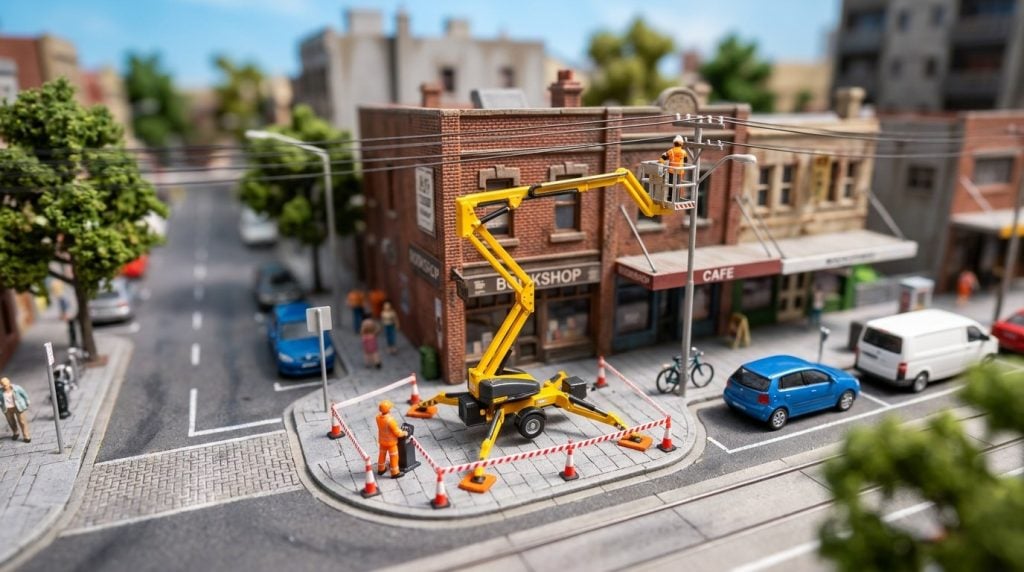
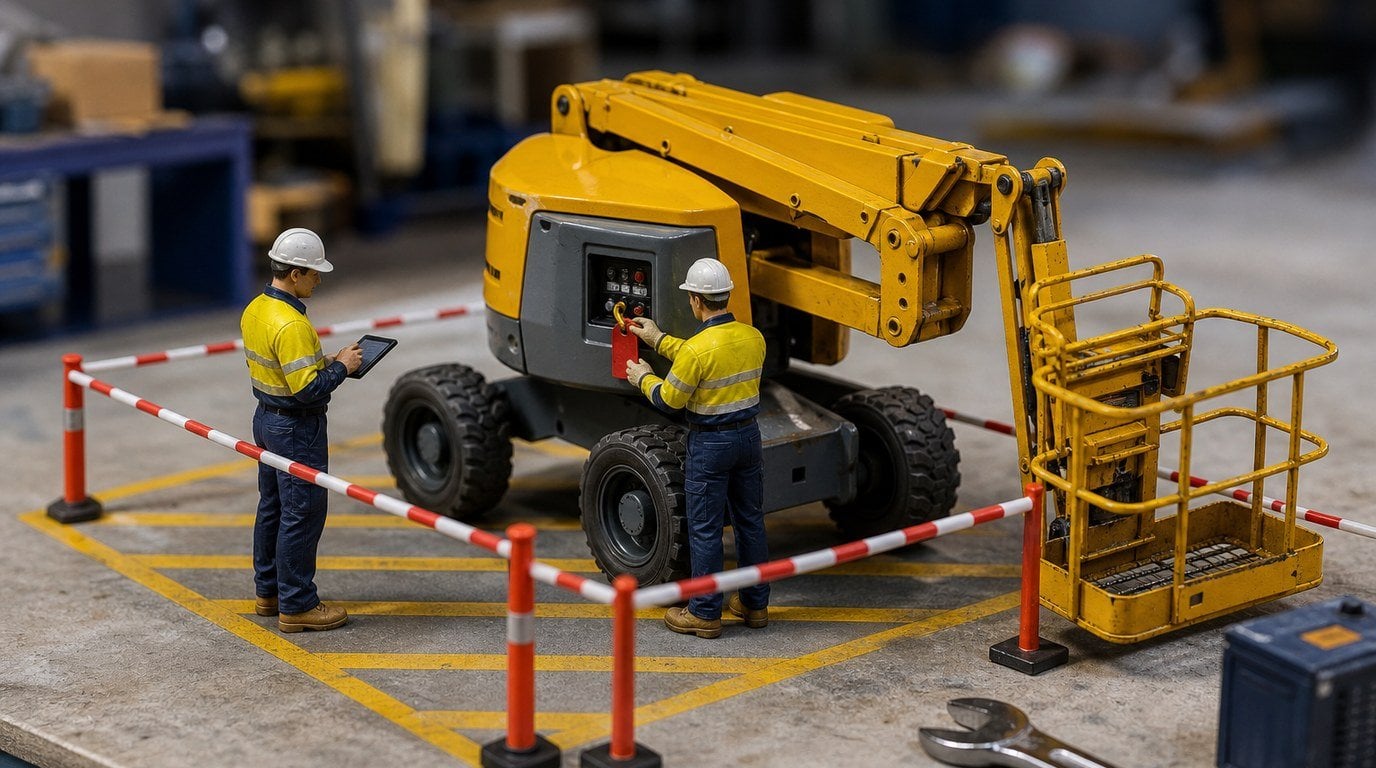
Broader than most people assume. The code defines an EWP as powered mobile plant designed to lift or lower people and equipment by a telescopic, hinged or articulated device from a base support, able to move without fixed runways. Internationally they are called MEWPs. The families named are knuckle booms, scissor lifts, self-propelled and telescoping boom lifts, trailer lifts, truck and vehicle mounted lifts, telehandlers and vertical mast lifts.
Two boundary calls belong in your induction material. A telehandler or integrated tool carrier is an EWP when it is configured and fitted as one, with basket controls and ground controls for rescue, and is not when fitted with forks or a jib. A forklift fitted with a work platform is not an EWP, and the code says plainly it should not be used in place of one. Nor is a crane suspending a workbox.
Duties overlap rather than hand off, which is what hire arrangements get wrong. If you hire an EWP, you have management or control of it for the hire period. So does the hire company. The code is direct about what that means: the duties include who inspects it, who keeps the logs, who verifies the high risk work licence, and who controls modifications. Four questions. If your hire paperwork answers none of them, both parties are assuming the other did it. The general plant duties sit underneath and apply to every machine on site.
A court has now put a price on these controls
On 24 August 2026 the Melbourne Magistrates’ Court sentenced two companies over the death of a 25-year-old worker in a boom lift at a North Blackburn construction site in August 2023. He was crushed against an overhead steel frame while installing safety mesh for future roofing works. Both companies had pleaded guilty.
Ridge Commercial Pty Ltd, which owned the boom lift, was convicted and fined $400,000 on two charges of failing to provide or maintain a safe workplace. Licojo Pty Ltd, whose technician had serviced the machine that morning, was convicted and fined $230,000 on a single charge of failing to ensure that persons other than employees were not exposed to risk. Each was ordered to pay $5,525 in costs.
WorkSafe’s investigation found that no spotter was being used for the task, and that the operator protection alarm fitted to the boom lift had been disconnected.
The measures the court identified as reasonably practicable are the ordinary ones. For the owner: a system requiring employees to conduct and document daily pre-start inspections, to remove the machine from service where a safety malfunction or problem was found, and to arrange a licensed safety observer on site. For the service company: to identify during the service that the alarm was not operational, and to keep the machine out of operation until it was rectified.
That is the overlapping duty described above, priced. Neither company had to be solely at fault for both to be convicted, and the service contractor’s duty attached to a machine it did not own and a worker it did not employ. If your business services, hires or maintains plant that other people’s workers stand in, that is the finding to read twice.
The risks the code names
Chapter 3 covers operational, ground condition, fall, electrical, falling object, noise, hazardous chemical and psychosocial risks. Three points will be new to people who learned this equipment on the job.
Ground conditions get the most space, deservedly. The code covers water in the soil, backfilled trenches, covered cavities, and ground with a crust that reads as firm and is not. A side slope of two or three degrees can have a drastic effect on stability with the boom telescoped out. The instruction that changes behaviour on site: where a geotechnical report exists for the building work, it should be given to the supplier of the EWP, and relied on only if it covers the ground the machine will stand on.
Electrical risk is handled through work zones. Zone C, nearest the line, needs supply authority approval. Zone B needs documented consultation with the supply authority, authorised persons and generally a safety observer. Worth extracting: safety observers must be reassessed annually on their competency to rescue and resuscitate, must not observe more than one operating EWP at a time, and must have authority to stop the work. A spotter given extra duties while spotting is treated as a psychosocial hazard, which is a neat way of saying a distracted spotter is not a control.
Falls need a harness on boom-type machines. A full harness secured to the anchor point is worn on the platform of a boom-type EWP because of the free fall risk. On other types it is a risk assessment decision, and note that South Australia’s fall threshold sits lower than the national one.
Licensing is the floor, not the ceiling
For a boom-type EWP with a boom length of 11 metres or more, the operator must hold the relevant high risk work licence, sighted and recorded at induction. Boom length is the greater of the vertical distance to the platform floor at maximum height, or the horizontal distance from the boom’s centre of rotation to the outer edge of the platform at maximum reach. Then the detail people argue about: boom length is taken from the original design, so alterations bringing it under 11 metres do not remove the licence requirement.
Below 11 metres no licence is required, and the duty of care does not move. The code is blunt about why: different types and brands have significantly different controls, and incorrect use of the controls can lead to a serious incident.
That is the difference between a licence and familiarisation, and it is the gap most systems have. A licence proves a person can operate a class of machine. Familiarisation proves they can operate this machine, with these controls, on this site. The code also asks that ground workers and spotters be trained on the emergency controls so they can lower the platform if needed, which people rarely think to record. Assuming familiarity is competence is the ground we covered in Dunning-Kruger and clause 7.2.
A safe work method statement is required for high risk construction work, and EWP work walks into that from three directions: a fall of more than 2 metres, work adjacent to a traffic corridor in use, and work near energised electrical services. It must be site-specific and prepared before work starts, so a generic SWMS from the last job is a document, not a control.
On a construction project above the cost threshold, that statement has a second reader. The principal contractor must take all reasonable steps to obtain a copy before the high risk work starts, and its own management plan has to set out the arrangements for collecting, assessing, monitoring and reviewing safe work method statements. A statement written on the morning the machine arrives is the one that collides with that duty.
Registration, inspection, and the modification nobody registers
Boom-type EWPs must be registered before use, and registrable designs must be design registered before supply and commissioning, with the certificate number accessible near the machine. Requirements vary between states and territories.
The clause that catches people is alteration. If a registered design is altered in a way that may affect health and safety, the altered design must be registered. The examples include non-like-for-like changes to engines, drives, brakes, control systems or boom sections; signage with greater wind area or mass; attachments not in the original design; and, notably, fitting proximity sensors that interrupt EWP functionality. That last one is the trap. A business fits sensors to reduce crush and powerline risk, exactly the engineering control the hierarchy asks for, and creates an obligation it has never heard of.
On inspection, the code requires that parts subject to wear, damage, corrosion and abrasion are repaired or replaced well before they fail, and that maintenance, inspection and testing is carried out by a competent person. Safe Work Australia’s guidance sets out the inspection types the code covers: pre-operational, routine, periodic and major, in accordance with the manufacturer’s recommendations, with checklists in the appendices. The auditable question is not whether inspections happen. It is whether they leave a trace, and what I look for is a pre-start page where the answer was no, and what happened next.
The rescue plan, which almost nobody has
This is where the code is most useful and where most duty holders have done the least thinking. A worker in a boom-type EWP is wearing a harness. The machine faults, or the operator is incapacitated, or the platform is trapped against a structure. What happens next? “Call triple zero” is not a plan, because harness suspension is time-critical.
The code requires an emergency plan and then adds the EWP-specific pieces:
Rescue equipment should be available and easily accessible, or on standby for higher risk work, with processes for rescuing an injured worker, particularly if suspended in a harness.
Emergency lowering procedures vary significantly between brands and models. Workers must be trained in the controls at the base of the machine, and the lowering path must be clear so the lowering does not cause a crush injury.
The machine must be sited so the emergency controls are not obstructed, and emergency lowering requires pre-operational inspection and testing. An untested ground control is an assumption.
The plan may include expected rescue times for the emergency lowering controls specific to each model on site. Per model. Run three brands and you need three measured rescue times.
A rescue plan naming a machine you no longer hire is worse than none, because everyone downstream assumes it works. Same failure mode as critical control verification.
What an auditor asks for
If I were auditing your EWP work tomorrow, this is the thread I would pull. It is a useful self-test even if nobody is coming.
The machine list. Every EWP on site, hired ones included, and any telehandler configured as one.
The hire agreement. Who inspects, who logs, who verifies the licence, who controls modifications.
The operator. Licence recorded where required, plus familiarisation on this make and model.
The ground crew. Who can operate emergency lowering, and when did they last practise.
The records. A site-specific SWMS, pre-start checks with a defect that closed, competent person inspections.
The rescue plan. Model-specific, with a rescue time somebody has measured.
The loop back. Did any of it reach management review, and did anything change?
Points 4, 6 and 7 are where most systems break, and they are the same failure wearing three hats.
Where this comes unstuck
Treating the hire company as the safety system. A hired EWP delivered with no inspection record is your control failure, not theirs.
Assuming a contractor’s machine is the contractor’s problem. If a subcontractor brings its own EWP onto your site, your duty does not wait at the gate. The Licojo conviction above is that overlap priced, and we set out how the contractor management duty works in someone else’s worker on someone else’s plant.
Familiarisation that is a signature, and rescue plans written for a fleet you no longer run. Models change every hire.
No project plan. This one quietly costs the most on a certification build. Businesses decide to implement ISO 45001, start on documents, and never produce a plan with dates, owners and dependencies. It matters because the plan is shared with the certification body so they can schedule Stage 1 and Stage 2. Without it, audit dates suit the certifier’s diary rather than your readiness, and a business that would have been ready in five months finds Stage 2 booked for a date it cannot meet.
How ISO 45001 keeps it true
None of this needs a management system. What a system does is stop it decaying. Clause 6.1.3 asks you to determine your legal requirements, which is where a new code has to land rather than sit unread. Clause 8.1 turns EWP work into a process with criteria and retained records, and extends control to procurement and contractors, which is where hired plant lives. Clause 9.1.2 asks you to evaluate compliance rather than list obligations. And clause 10.2 governs nonconformity, because finding a problem is not the failure. Finding it and doing nothing traceable is, which is what a regulator looks for too, as we set out in the SafeWork NSW 2026-27 regulatory priorities. The same applies to all plant, not only the machines that go up.
Where Streamline fits
Most businesses using EWPs are not careless. They are running equipment their people know well against a benchmark that changed while they were busy.
Streamline is run by a practising ISO Lead Auditor, so you get the view from the other side of the audit table. We run independent gap analysis audits that tell you where your plant registers, hire arrangements, competence records and rescue plans stand against ISO 45001 and the codes that apply to you. We provide the independent internal audit your system needs under clause 9.2, we build ISO 45001 systems end to end, and ISO mentoring guides your own people if you would rather build in-house.
For most small and medium Australian organisations, ISO 45001 certification takes three to six months and a first-year investment of roughly $7,000 to $25,000. Built as part of an integrated management system alongside quality or environmental, the cost per standard runs at about 50 to 75 per cent of standalone.
Start with one machine and one question: if the operator could not lower themselves, who lowers them, how long would it take, and has anyone timed it? If that has no answer, get in touch.
Sources
Safe Work Australia, model Code of Practice: Elevating work platforms, December 2025, and the Safe Work Australia announcement confirming it replaces the guide to managing the risks of elevating work platforms and the guide to inspecting and maintaining elevating work platforms.
Safe Work Australia, elevating work platforms managing risks guidance, for the inspection types the code covers.
SafeWork NSW, Elevating work platforms Code of Practice, July 2026, including the NSW editorial note recording gazettal and commencement on 10 July 2026.
Work Health and Safety Act 2011 (NSW) section 26A, in force 1 July 2026.
Model Work Health and Safety Act sections 19, 22 to 27, 43 and 274, and model WHS Regulations covering plant, falls, high risk work licensing, safe work method statements and emergency plans, as cited within the code. The code also refers to AS 2550.10 and AS/NZS 1418.10 for safe use of mobile elevating work platforms.
WorkSafe Queensland published list of codes of practice, checked 19 August 2026.
ISO 45001, clauses 6.1.3, 7.2, 8.1, 9.1.2, 9.2 and 10.2.
This article is general information from an auditing and management system perspective. It is not legal advice, and it does not comment on any current incident, investigation or proceeding. Model codes of practice are approved jurisdiction by jurisdiction, so check with your regulator which apply to you.
General guidance only. This article is general information, not legal, financial, safety or compliance advice, and it does not take account of your specific circumstances. Streamline ISO Consultants are ISO management-system consultants, not lawyers or licensed advisers. Standards, laws and regulator guidance change, and details were correct only at the time of writing. Always seek professional advice before acting. See our full Disclaimer.
Stay in the Loop
Get an email when we post an article. Your email address will not be used for marketing, and you can unsubscribe at any time.
Om nom nom... COOKIES! The essential ones keep our site working, and a few others help us see how it is used so we can make it better. Your call: accept the whole batch, keep it to essentials only, or pick your preferences. The full recipe is in our privacy policy.
Cookie Preferences
Manage your cookie preferences below:
Essential cookies enable basic functions and are necessary for the proper function of the website.
Name
Description
Duration
Cookie Preferences
This cookie is used to store the user's cookie consent preferences.
30 days
You can find more information in our Privacy Policy and .