Emergency Preparedness Is Not an Evacuation Plan (ISO 45001 Clause 8.2)
Open many safety management systems, turn to clause 8.2, and you will find an evacuation diagram, a muster point and a fire warden roster. That is not clause 8.2. It is one small corner of it, and treating the two as the same thing is one of the most common gaps I see as an auditor. The number of systems that call an evacuation plan “emergency preparedness and response” is not funny, because the day it matters, the gap is a person on the ground.
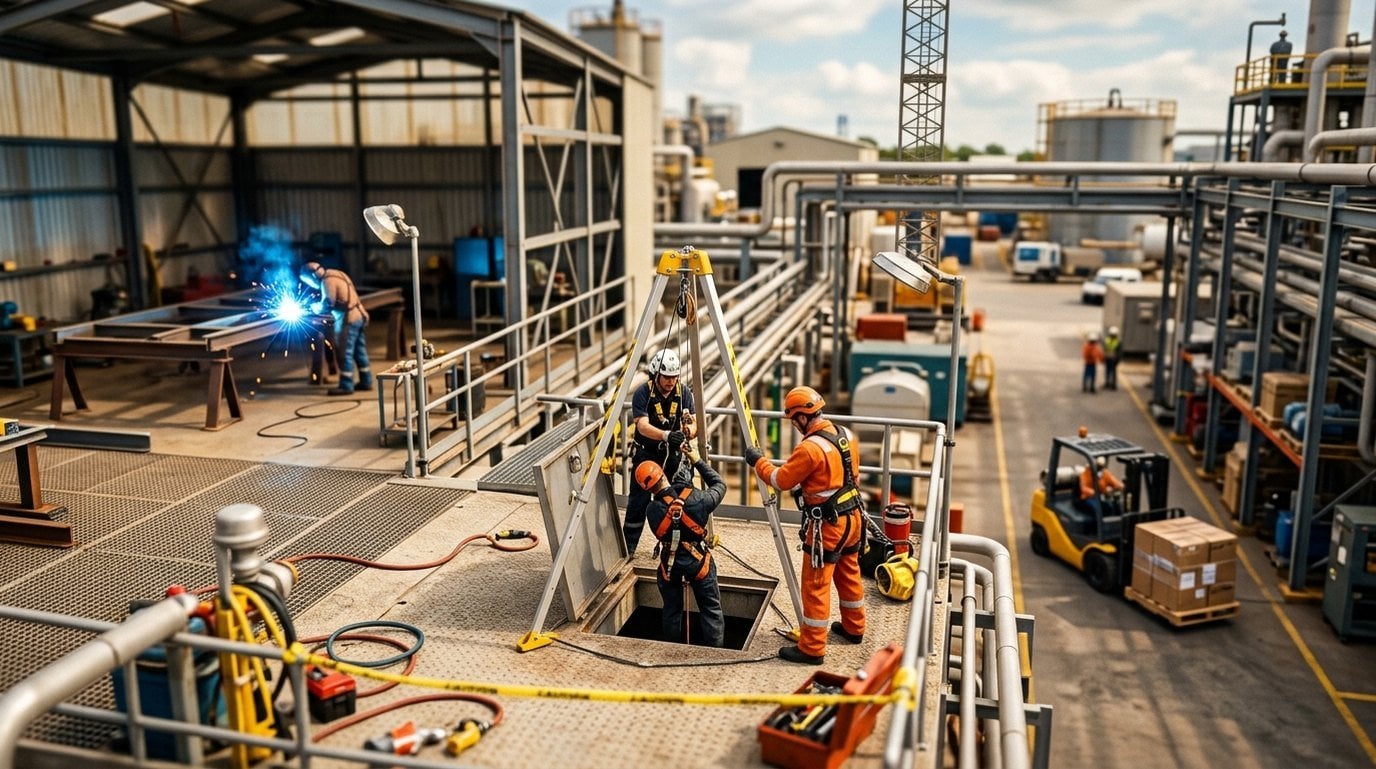
Real emergency preparedness is a hazard-matched response you have rehearsed, like a confined-space rescue, not a walk to a muster point.
The clause tells you where to start, and it is not the fire exits
ISO 45001 clause 8.2 requires a process to prepare for and respond to potential emergency situations “as identified in 6.1.2.1.” Those five words are the whole point. Your emergencies are not a generic list you download and rebadge. They are the ones that flow from your own hazards.
Clause 6.1.2.1 is hazard identification, and it explicitly asks you to take into account past relevant incidents, including emergencies, and potential emergency situations. So the standard draws a straight line: hazards first, then the emergencies those hazards can produce, then the response. Emergency preparedness sits downstream of hazard identification. If your emergency plan was not built from your hazard register, you have skipped the step the standard is actually asking for.
An evacuation covers one scenario: get everyone out and to a safe point. It does nothing for the electrician who takes a shock and is still in contact with a live conductor, the welder with deep burns or an arc flash, or the pedestrian caught by a reversing forklift. Each of those is a foreseeable emergency arising from a specific hazard, and each needs its own response. Evacuating the building does not rescue the person lying next to the machine.
Clause 8.2 done properly is a five-step chain
Each link ties back to a part of the standard:
Identify the hazards (clause 6.1.2.1). Ongoing and proactive, across routine and non-routine work, plant, substances, human factors and how the work is actually performed.
Establish the credible emergency scenarios each hazard could produce. A hazard is not an emergency. The emergency is what happens when control of that hazard is lost.
Develop the response for each scenario: the procedure, the people, the equipment and the training to match. This is clause 8.2 a) and b).
Test it. Run a scheduled program of exercises that rehearse the actual response, not just a walk to the car park, and validate that the plan works. This is clause 8.2 c), and it is where most systems fall over.
Capture the lessons and improve. Every exercise, and every real event, feeds back into the plan. This is clause 8.2 d).
What that looks like on a real site
The response depends entirely on the work. A few examples of the mapping from hazard, to the emergency it can produce, to what the response actually has to include:
Work / hazard
Credible emergency
What the response actually needs
Live or low-voltage electrical work
Electric shock, worker still in contact with a live conductor
A low-voltage rescue kit on site, a trained rescuer, a written rescue procedure, and a drill that rehearses isolation and rescue, not just first aid afterwards
Hot work and welding
Serious burns, arc flash, fire or explosion
Burn first aid and casualty management, fire response with extinguishers matched to the fuel, and an exclusion and response plan where compressed or flammable gases are in play
Weld cleaning with pickling paste (hydrofluoric acid)
HF skin or eye exposure, which can cause systemic poisoning, not just a surface burn
Calcium gluconate gel kept on site, immediate and prolonged flushing, a written exposure procedure, urgent medical escalation, and a crew who know HF is a medical emergency even when the skin looks fine
Forklifts and mobile plant
Pedestrian struck, worker pinned
A plant-versus-person response, immediate isolation of the plant, casualty management, and a drill run against your actual traffic-management setup
Confined space entry
Oxygen deficiency, toxic or flammable atmosphere, engulfment, a worker collapsed inside
Atmospheric monitoring, an entry permit and a trained standby person, non-entry retrieval gear (tripod, winch, harness) and a rehearsed rescue, because a large share of confined-space deaths are untrained rescuers who went in after the first casualty
Office or other “low-hazard” workplace
Sudden cardiac arrest, more likely with an older or sedentary workforce
An AED on site, staff who know where it is, and trained first aiders, all decided before it happens rather than during
The pickling row is the one that catches people out. Cleaning a weld does not feel like an emergency waiting to happen, and yet the response it needs, calcium gluconate on the shelf and a crew who know to reach for it, has to be in place long before anyone opens the tub. No evacuation plan will ever produce that. It only happens by looking honestly at the hazard, which is exactly the path from 6.1.2.1 to 8.2.
And do not assume this is only for workshops and sites. The most common version of the mistake is the office that decides it has no hazards worth planning for. An office is full of people, and people have medical emergencies. A sudden cardiac arrest is foreseeable in any workplace, and survival falls by roughly 10 per cent for every minute until defibrillation, so where the defibrillator is, and who is trained to use it, has to be settled long before the day. “We have an office, so we do not have any hazards” is the reasoning that ends with someone doing chest compressions next to a photocopier while a colleague reads the AED instructions for the first time. “Call an ambulance and wait” is the office version of walking to the muster point.
The same honest look turns up scenarios nobody wrote down. A flooring crew working with epoxy resins may know that some people develop an allergic skin reaction, which once triggered stays for life, but if the response lives only in the supervisor’s head it is not a plan. A spill is the same: a spill kit on the ute is not a response if nobody has been shown how to use it. Write down the most likely scenarios for each work area, the office, the warehouse and the site, even if each one runs to only a few lines.
The two parts everyone skips
Even systems that get the rest right tend to skip the last two steps, and they are the ones that decide whether the plan works.
Testing (clause 8.2 c) means exercising the response so you find the gaps before an incident does: the rescue kit nobody could locate, the procedure that assumed two first-aiders when one is on leave, the emergency-services number that was never confirmed. An exercise is not a fire drill. It is a rehearsal of the specific response to a specific scenario, and it is the only honest test of whether any of this works. An independent internal audit will tell you quickly whether your exercises are real or a tick in a box.
Part of every test is how the alarm gets raised. In a noisy plant or a large yard, a shout does not carry and there may be no building alarm at all. Air horns at set points around the facility, with everyone knowing what a blast means, are a cheap and effective fix. A plan nobody can trigger is not a plan.
Revision (clause 8.2 d) means the plan changes after every exercise and every real event. A response plan that has not changed in three years has either never been tested or never learned anything. The standard is explicit that you evaluate and, as necessary, revise, in particular after exercises and after actual emergencies.
And it does not stop at your own workers
Clause 8.2 also asks you to communicate the plan to your workers (8.2 e), to contractors, visitors, emergency services and, where relevant, the local community (8.2 f), and to take account of relevant interested parties in developing it (8.2 g). The people who turn up when it goes wrong should not be reading your plan for the first time on the day.
On someone else’s site
Contractors on a client’s or a builder’s site face a different question. Where there is a principal contractor, you are inducted into their emergency procedures and you follow them, and your own plan should say exactly that. A response is hard to test on someone else’s site, so test what you control: your office, your workshop or warehouse, and the jobs where you run the site yourself. Where you take control of a work area in an existing building and nobody else is running it, the plan, and telling people what it is, falls to you. A site-specific pre-start that covers the emergency arrangements is a simple way to show it.
Why this is worth getting right
This is not paperwork for its own sake. When an emergency is handled badly, it is a person who is hurt, and increasingly it is an officer who has to show they took reasonable steps to manage a risk they knew about. A clause 8.2 process built from your real hazards, resourced with the right equipment and training, and rehearsed, is exactly the kind of evidence the officer’s due-diligence duty asks for. An evacuation diagram is not.
If your emergency preparedness is a muster point and a fire warden, it is not meeting clause 8.2, and more to the point, it is not protecting your people. Emergency preparedness that actually works starts where the standard tells you to start: with your hazards.
Speak with an experienced ISO auditor
Streamline builds ISO 45001 safety management systems that start from your hazards and end with an emergency response you have actually tested, not a fire drill standing in for the lot. We can build it with you, run the independent internal audit that checks it would hold up, or mentor your team to do it themselves. Email hello@streamline.business or call us:
General guidance only. This article is general information, not legal, financial, safety or compliance advice, and it does not take account of your specific circumstances. Streamline ISO Consultants are ISO management-system consultants, not lawyers or licensed advisers. Standards, laws and regulator guidance change, and details were correct only at the time of writing. Always seek professional advice before acting. See our full Disclaimer.
Stay in the Loop
Get an email when we post an article. Your email address will not be used for marketing, and you can unsubscribe at any time.
Om nom nom... COOKIES! The essential ones keep our site working, and a few others help us see how it is used so we can make it better. Your call: accept the whole batch, keep it to essentials only, or pick your preferences. The full recipe is in our privacy policy.
Cookie Preferences
Manage your cookie preferences below:
Essential cookies enable basic functions and are necessary for the proper function of the website.
Name
Description
Duration
Cookie Preferences
This cookie is used to store the user's cookie consent preferences.
30 days
You can find more information in our Privacy Policy and .